GAIOOP
Generative-AI platform for learning object-oriented software development — cut a build from ~1 week to 6–8 hours, and a controlled study showed measurable learning gains. Svelte / Flask / PostgreSQL, in-browser IDE, fine-tuned code model (NTCU Smart Education Center).
GAIOOP — Generative AI Object-Oriented System Development Platform. Built with a team for the NTCU Smart Education Center; I led the system design and wrote most of the code.
GAIOOP is an innovative learning platform whose core goal is to use generative AI to strengthen students’ ability to build software systems and apply object-oriented techniques. It started as a campus Smart Education Center project that four seniors and I applied for together; my part covered conceiving the system, planning the architecture, system design, and writing most of the code.
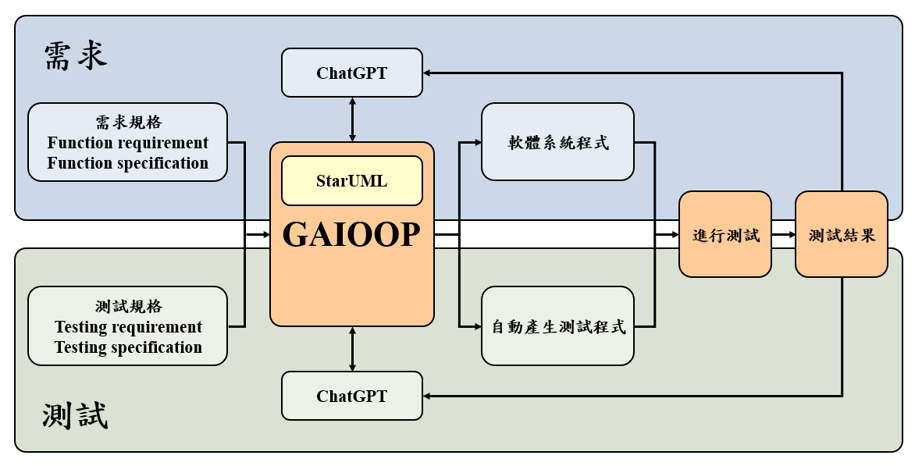
The workflow mirrors real software design: students express a system’s design as UML in StarUML, and generative AI fills in the code inside that framework from the software specification — turning design into working code so students practice object-oriented development hands-on.
GAIOOP is currently in active use, teaching the object-oriented programming course in the NTCU Computer Science department. (The source code is not publicly available.)
What it does
Delivering this took heavy up-front design and, for the time, cutting-edge generative AI. The main capabilities:
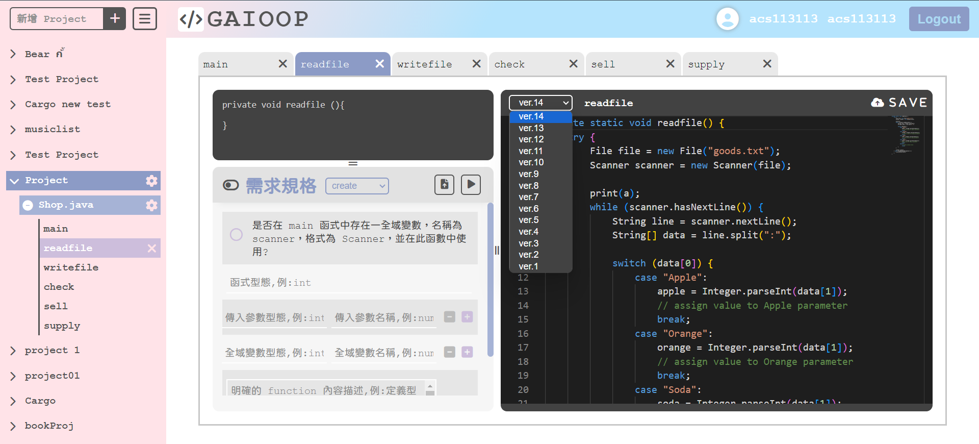
- Skeleton from UML. Students upload a StarUML model; we parse it with regular expressions to decide how to split files and the functions inside them — regex turned a previously slow splitting step into a fast, reliable one.
- AI code generation (the core). From a user-filled requirements form, our engineered prompts, and a later fine-tuned model, the platform generates the code inside the framework. In testing it cut work that used to take about a week down to roughly 6–8 hours.
- Unit testing. For each generated function, users can run unit tests via generative AI + JUnit to verify correctness.
- Git-like versioning with MinIO. We used MinIO to record versions of both the requirements and the generated code, so users can roll back to a previous version much like Git — one of the trickier parts we spent significant time getting right.
- In-browser Web IDE. We built an online IDE on Monaco Editor (the editor behind VS Code and others), so users can edit the AI-generated code directly in the browser.
Key tech: Svelte (frontend) · Flask (backend) · PostgreSQL (database) · MinIO (object storage) · Monaco Editor (in-browser IDE) · Generative AI with a fine-tuned code-generation model.
Does it actually help? — a controlled study
To check whether the platform genuinely helps students learn OO, we ran a controlled experiment inside the object-oriented programming course. Using midterm scores, we split students evenly into Group A and Group B: Group A used GAIOOP to learn system development before finals; Group B did not. At the final, both groups had 6 hours to build a small system, which we auto-graded.
An independent-samples t-test on the results showed that students who learned with GAIOOP outperformed those who did not. The gap was small among top-performing students, but noticeably larger among lower-performing students — suggesting the platform helps most the students who need it most.
Status: a journal manuscript based on this platform and study is currently under review at Education and Information Technologies (Springer), submitted August 2026.