Coding
847. Shortest Path Visiting All Nodes
On this page
⭐⭐⭐⭐⭐
題目敘述
You have an undirected, connected graph of n nodes labeled from 0 to n - 1. You are given an array graph where graph[i] is a list of all the nodes connected with node i by an edge.
Return the length of the shortest path that visits every node. You may start and stop at any node, you may revisit nodes multiple times, and you may reuse edges.
Example 1
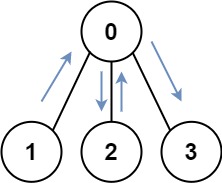
Input: graph = [[1,2,3],[0],[0],[0]] Output: 4 Explanation: One possible path is [1,0,2,0,3]
Example 2
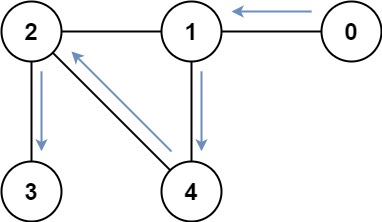
Input: graph = [[1],[0,2,4],[1,3,4],[2],[1,2]] Output: 4 Explanation: One possible path is [0,1,4,2,3]
解題思路
Use BitMask + BFS
運算式介紹:
allVisitedMask = (1 << n) - 1: 運算結果為15,以二進位來查看為1111,用於表示全部節點都走過了。currMask: 表示當前queue中經過了那些節點。newMask = currMask | (1 << next): 表示經過下一個node(next) 後的所有經過節點,|運算子稱作OR,運算方式如:0011 | 0101 = 0111。
BFS 結束條件:
- 如果經過相同
node(newMask),且下一個去向也是相同node(next),visited[newMask][next] == true,可以不用再跑下去。 - 如果
currMask == allVisitedMask表示所有節點都走過了,而currLen - 1就是答案。
Solution
import java.util.Arrays;
import java.util.LinkedList;
import java.util.Queue;

class Solution {
    public int shortestPathLength(int[][] graph) {
        int n = graph.length;
        int allVisitedMask = (1 << n) - 1;
        Queue<int[]> queue = new LinkedList<>();

        boolean[][] visited = new boolean[allVisitedMask + 1][n];
        for (boolean[] v : visited) {
            Arrays.fill(v, false);
        }

        for (int currNode = 0; currNode < n; currNode++) {
            int initialMask = (1 << currNode);
            queue.add(new int[] { currNode, initialMask, 1 });
            visited[initialMask][currNode] = true;
        }

        while (!queue.isEmpty()) {
            int[] curr = queue.poll();

            int currNode = curr[0];
            int currMask = curr[1];
            int currLen = curr[2];

            if (currMask == allVisitedMask) {
                return currLen - 1;
            }

            for (int i = 0; i < graph[currNode].length; i++) {
                int next = graph[currNode][i];
                int newMask = currMask | (1 << next);

                if (visited[newMask][next]) {
                    continue;
                }

                queue.add(new int[] { next, newMask, currLen + 1 });
                visited[newMask][next] = true;
            }
        }

        return -1;
    }
}