785. Is Graph Bipartite?
⭐⭐⭐
題目敘述
There is an undirected graph with n nodes, where each node is numbered between 0 and n - 1. You are given a 2D array graph, where graph[u] is an array of nodes that node u is adjacent to. More formally, for each v in graph[u], there is an undirected edge between node u and node v. The graph has the following properties:
- There are no self-edges (
graph[u]does not containu). - There are no parallel edges (
graph[u]does not contain duplicate values). - If
vis ingraph[u], thenuis ingraph[v](the graph is undirected). - The graph may not be connected, meaning there may be two nodes
uandvsuch that there is no path between them.
A graph is bipartite if the nodes can be partitioned into two independent sets A and B such that every edge in the graph connects a node in set A and a node in set B.
Return true if and only if it is bipartite.
Example 1:
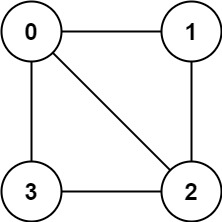
Input: graph = [[1,2,3],[0,2],[0,1,3],[0,2]] Output: false Explanation: There is no way to partition the nodes into two independent sets such that every edge connects a node in one and a node in the other.
Example 2:

Input: graph = [[1,3],[0,2],[1,3],[0,2]] Output: true Explanation: We can partition the nodes into two sets: {0, 2} and {1, 3}.
解題思路
Solution
class Solution {
    public boolean isBipartite(int[][] graph) {
        int n = graph.length;
        int[] remeber = new int[n];
        // remeber graph index in which group, group A = 1, group B = -1

        for (int i = 0; i < n; i++) {
            if (remeber[i] == 0 && !dfs(graph, remeber, i, 1))
                return false;
        }

        return true;
    }

    public boolean dfs(int[][] graph, int[] remeber, int node, int group) {
        if (remeber[node] != 0)
            return remeber[node] == group;

        remeber[node] = group;
        for (int neighbor : graph[node]) {
            if (!dfs(graph, remeber, neighbor, -group))
                return false;
        }
        // if neighbor node is not in same group, mean it can divide to two group.

        return true;
    }
}