Coding
2331. Evaluate Boolean Binary Tree
On this page
⭐
題目敘述
You are given the root of a full binary tree with the following properties:
- Leaf nodes have either the value
0or1, where0representsFalseand1representsTrue. - Non-leaf nodes have either the value
2or3, where2represents the booleanORand3represents the booleanAND.
The evaluation of a node is as follows:
- If the node is a leaf node, the evaluation is the value of the node, i.e.
TrueorFalse. - Otherwise, evaluate the node’s two children and apply the boolean operation of its value with the children’s evaluations.
Return the boolean result of evaluating the root node.
A full binary tree is a binary tree where each node has either 0 or 2 children.
A leaf node is a node that has zero children.
Example 1
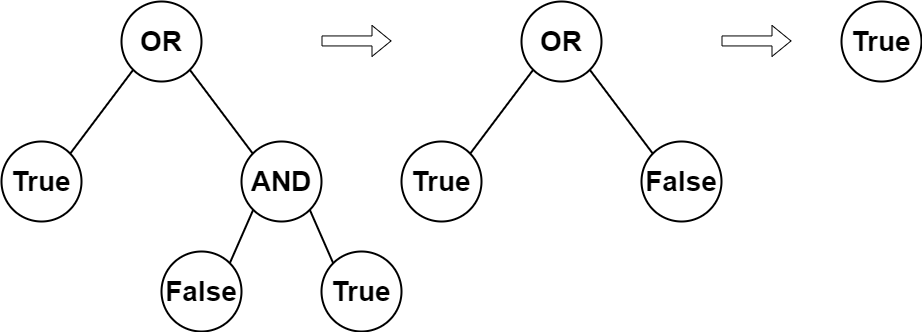
Input: root = [2,1,3,null,null,0,1] Output: true Explanation: The above diagram illustrates the evaluation process. The AND node evaluates to False AND True = False. The OR node evaluates to True OR False = True. The root node evaluates to True, so we return true.
Example 2
Input: root = [0] Output: false Explanation: The root node is a leaf node and it evaluates to false, so we return false.
TreeNode 的 class 內容
// Definition for a binary tree node.

public class TreeNode {
    int val;
    TreeNode left;
    TreeNode right;

    TreeNode() {
    }

    TreeNode(int val) {
        this.val = val;
    }

    TreeNode(int val, TreeNode left, TreeNode right) {
        this.val = val;
        this.left = left;
        this.right = right;
    }
}
解題思路
Solution
class Solution {
    public boolean evaluateTree(TreeNode root) {
        return dfs(root);
    }

    public boolean dfs(TreeNode root) {
        if(root.val == 3) return dfs(root.left) && dfs(root.right);
        else if(root.val == 2) return dfs(root.left) || dfs(root.right);

        return root.val == 1 ? true : false;
    }
}